



Just as the 1907 adoption of the metric carat replaced the inconsistent carob seed with scientific precision, the gemstone industry is facing a second ‘standardization moment’. Today, the multi-billion dollar market still relies on subjective trade terms like ‘Pigeon Blood’, creating a ‘Lab Gap’ that erodes Customer confidence and retards trade. By utilizing AI-powered colorimetry and the KNN algorithm that respects the historical opinion of gem-labs , the industry can finally translate the complex mosaic of a gem’s color into objective, verifiable data.

Vincent Wong(1) | Chua Han Chong(1) | Gamitha Amarasena(2) | Bhagya Wimalasiri(2) | Koh Pei Qing(1) | Chan Yee Ning(1)
(1) Porolis Technologies (2) Gemmological Institute of Colombo

January 23, 2026
The Multi-Million Dollar Guessing Game
In the 19th century, gemstone weight was a matter of geography and agriculture. Traders used carob seeds as counterweights, unaware that a seed in London might differ from one in Lisbon. This ambiguity ended in 1907 with the standardization of the metric carat (0.2 grams). It was the industry’s first great leap into modern commerce.
Today, we are living through the ‘carob seed’ era of colour. While diamond valuation is governed by the rigid precision of the 4Cs, the multi-billion dollar coloured gemstone market remains a ‘wild west’. We still rely on evocative descriptors like “Pigeon’s Blood” or “Royal Blue” to justify seven-figure price tags. These are not technical specifications, but high-stakes ‘professional judgments’ – the 2026 equivalent of a carob seed. We are now at a second 1907 Moment, the transition to GemTech 3.0, where Artificial Intelligence (AI) finally standardizes the most subjective variable in luxury : colour.
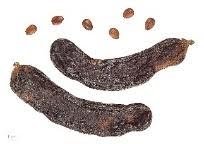
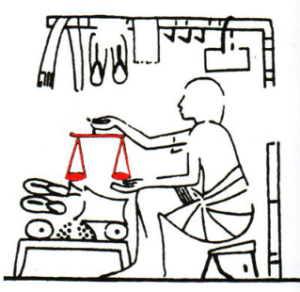
Before 1907, gemstone weight relied on carob seeds, a natural measure that varied by place and time. The metric carat ended this ambiguity and marked the beginning of modern gem trade.
Your Gemstone is a ‘Three-Dimensional Mosaic’, Not a Single Colour
To the untrained eye, a ruby is red. To the gemmologist, it is a nightmare of statistical variance. As Richard Hughes of Lotus Gemmology famously observed, coloured gemstones do not display a single hue, they are “three-dimensional mosaics of colour” that shift with every tilt of the stone or flicker of the light.
When we grade a faceted gem, the human brain must perform hundreds of thousands of mental iterations to ‘average out’ four distinct perception zones :
- Brilliant regions : Where light returns directly, showing peak saturation.
- Extinction regions: Dark ‘dead zones’ where light is lost.
- Window regions: Pale areas where light leaks through the pavilion.
- Reflection regions: Surface flashes that mask the internal body colour.
The cognitive load on a human grader is immense. We are trying to assign a single value to a moving target. AI, however, processes these zones pixel-by-pixel, replacing mental ‘averaging’ with hard spectral data.
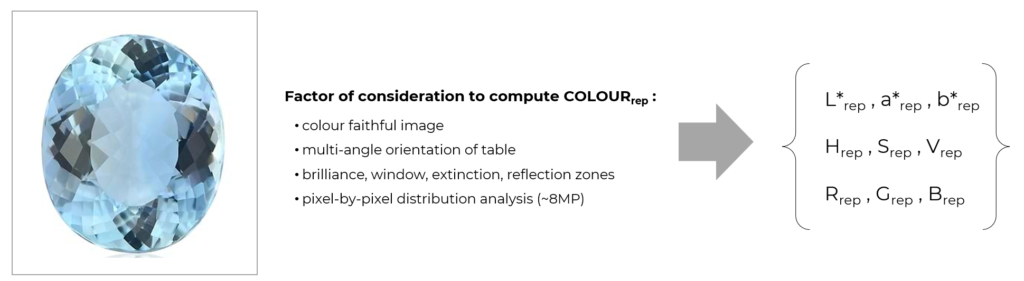
A faceted gemstone does not display one colour, but a shifting mosaic shaped by brilliance, extinction, windowing and reflection. AI learns and acquires the cognitive powers of gemmologists by processing these zones pixel-by-pixel, replacing mental ‘averaging’ with hard spectral data.
The "Lab Gap" – Why Six Gem-Labs Mean Six Different Opinions
The fragmented gem-lab landscape is a legacy bottleneck that AI can be designed to harmonise colour grading standards. Currently, top-tier labs (such as GIA, Gübelin, SSEF, Lotus, GIC, AGL) operate as silos, using proprietary master sets and varying nomenclature. This creates a ‘Lab Gap’ between Technical Results (scientific identification of a species) and Professional Judgment (the assignment of a prestigious trade name). While technical results are scientific, trade names often straddle a definitive line. Doug Hucker of the AGTA puts it bluntly: “The problem is there’s no uniformity. One stone may get two different color calls from two different labs.” For an investor, this lack of uniformity is more than a nuisance – it is a direct threat to the stone’s liquidity and value, thus hindering trade.
The Illusion of Geography – Lighting and the ‘North Skylight’ Dogma
For decades, the industry has maintained a blind adherence to ‘north skylight’ as the gold standard for grading. This is a geographical fallacy. Skylight in the tropics is significantly stronger than in temperate zones. Consequently, ’latitude may also affect a stone’s colour’, making gems bought in the tropics appear darker and more “closed” when they reach New York or London.
Beyond geography lies a physiological flaw: the Purkinje shift. Our eyes are biologically incapable of objective colour perception as light levels change. In bright light, we are more sensitive to red, whilst in dim light, we shift toward blue-violet. A human grader isn’t just fighting the weather, they are fighting their own retinas. AI colorimeters eliminate this biological bias by providing a controlled, standardized light environment that remains constant regardless of whether you are in a mine in Mogok or an office in Manhattan.
The Digital Barrier - Why Your Smartphone Can’t ‘See’ a High-Saturation Ruby
The inability to accurately trade high-end gems online isn’t just a technical glitch. Most high-saturation rubies and emeralds possess ’out-of-gamut’ colours – meaning hues are so intense they fall outside the range of standard Adobe RGB monitors or CMYK printing.
If a $100,000 stone looks identical to a $10,000 stone on a smartphone screen because both colours are clipped by the device’s gamut, the digital representation is useless. This barrier has forced the industry to remain a physical-presence business, slowing down the pace of global trade. AI-driven colorimetry is the key to unlocking digital trade by translating these ‘unseeable’ colours into objective, verifiable digital data.
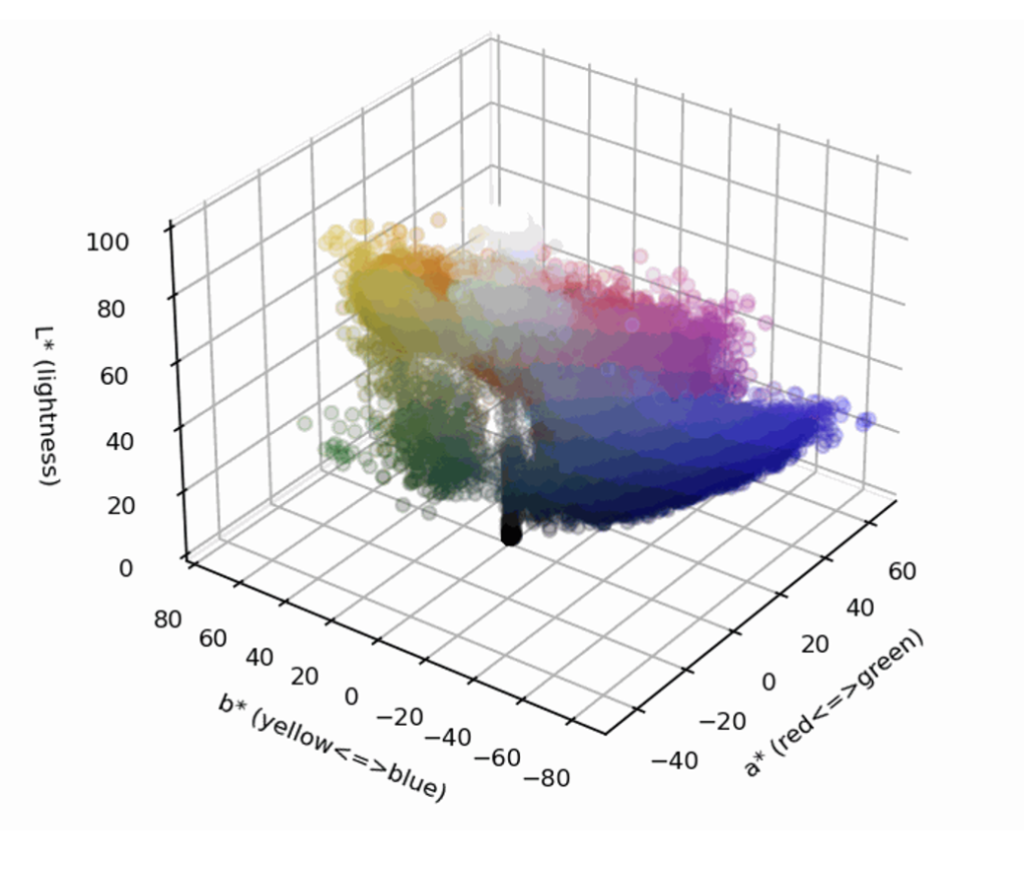
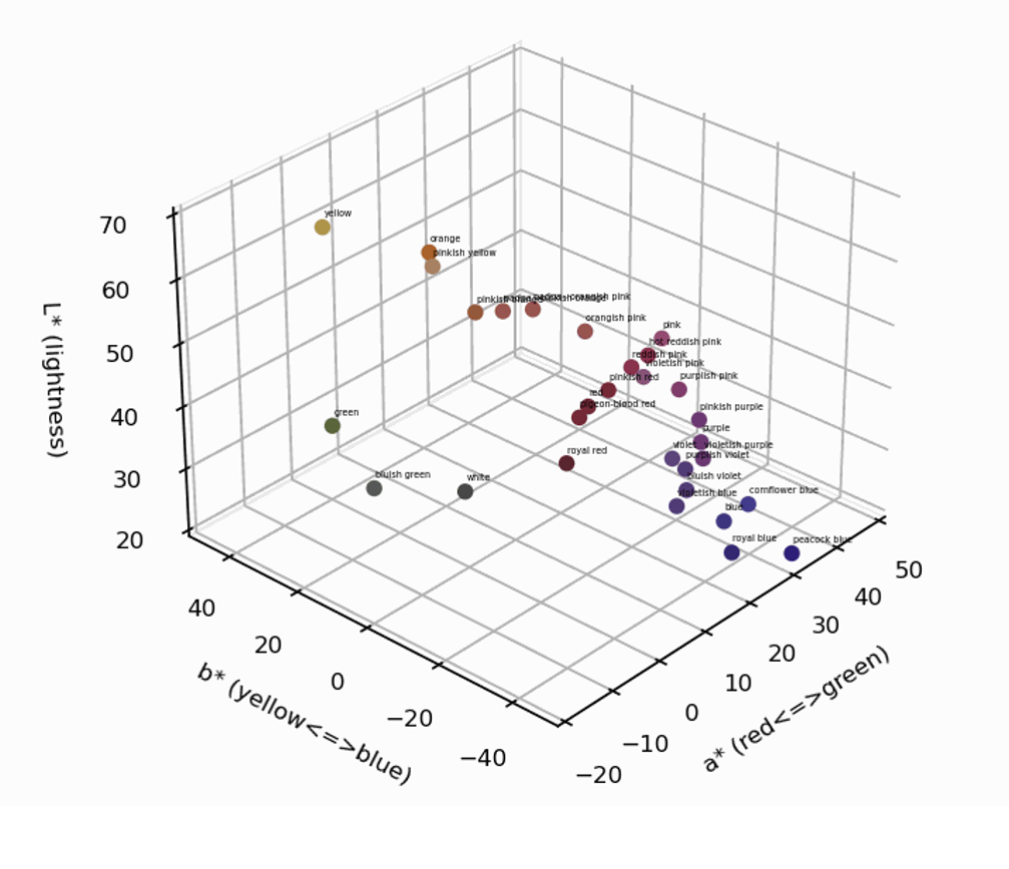
Initially trained on over 60,000 expert-labelled data points, the root AI model is designed with the capacity to respect the ‘political will and historical opinions’ of the other participating gem-labs, by merging their respective data contributions (and hence accompanying biases) creating a universal standard.
The 1907 Moment - How AI Cracked the Colour Code
The transition from carob-seed subjectivity to silicon-grade precision has arrived via AI-powered colorimeters like KROMA™ and the GemLUX® system. These technologies represent the definitive ‘1907 Moment’ for colour.
The breakthrough lies in the K-Nearest Neighbour (KNN) algorithm, a ‘lazy learner’ AI approach that is uniquely suited to the political realities of gemmology. The KNN algorithm does not overwrite the past, it incorporates it. Initially trained on over 60,000 expert-labelled data points, the root KNN-model is designed with the capacity to respect the ‘political will and historical opinions’ of other participating gem-labs, by merging their respective data contributions (and hence accompanying biases) hence creating a universal standard.
Unlike black-box AI, KNN is highly explainable. It shows exactly how a stone compares to a known dataset, alleviating the fear among labs that their past opinions will be rendered obsolete. This is not just a tool, it is a standardization layer that finally bridges the gap between different gem-lab opinions, democratizing elite gemmology for the entire value chain.
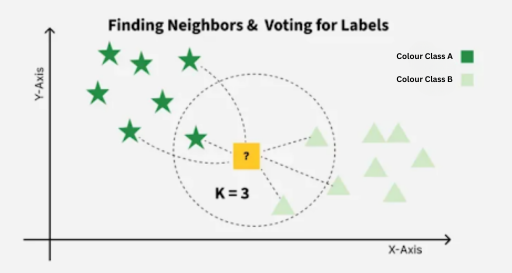
The breakthrough lies in the K-Nearest Neighbour (KNN) algorithm, a ‘lazy learner’ AI approach that is uniquely suited to the political realities of gemmology. The KNN algorithm does not overwrite the past, but incorporates historical opinions of world’s leading labs. Their authority is not surrendered, instead they reinforce the stability of the entire market.
The Economic Shift - Colour is the New Growth Engine
This technological innovation is being fuelled by a massive shift in consumer behaviour. Consumers and investors are looking for transparency, and the data suggests they are putting their money into colour :
- 11.3% CAGR : The projected growth rate for coloured stones through 2035, more than double the 4-5% growth of diamonds.
- 136% Import Surge : Growth in coloured gemstone imports (2020-2024) while diamond imports fell by 54%
- High-Yield Returns : Since 2020, investment-grade Emeralds have seen an 89% return, while rare Kashmir Sapphires have seen a 68% return.
The sector is on a trajectory to reach $5.7 billion by 2035. ‘Trust’ is the only friction point remaining, and AI is the lubricant that will allow this market to reach its full potential.
Conclusion - From Ancient Seeds to Silicon Standards
The adoption of AI-driven quantitative standards like KROMA™ and GemLUX® is the inevitable convergence of science and commerce. To remain relevant in an increasingly transparent global market, the gemstone industry must move past the era of proprietary ‘preferred branding’, and toward ‘gem-lab harmonization’. This is precisely the goal of Laboratory Manual Harmonisation Committee (LMHC) formed in 2001, bringing together 7 major international gemmological laboratories based in America, Asia and Europe to work towards the harmonisation of gemmological report language. This setting of standards mirrors the 1907 adoption of the metric carat. By contributing expertise to a shared AI model, the world’s leading labs do not surrender their authority, in fact they reinforce the stability of the entire market. For the Gen-Z and Gen-Alpha consumers, who are AI-native and demand radical transparency, this shift is non-negotiable.